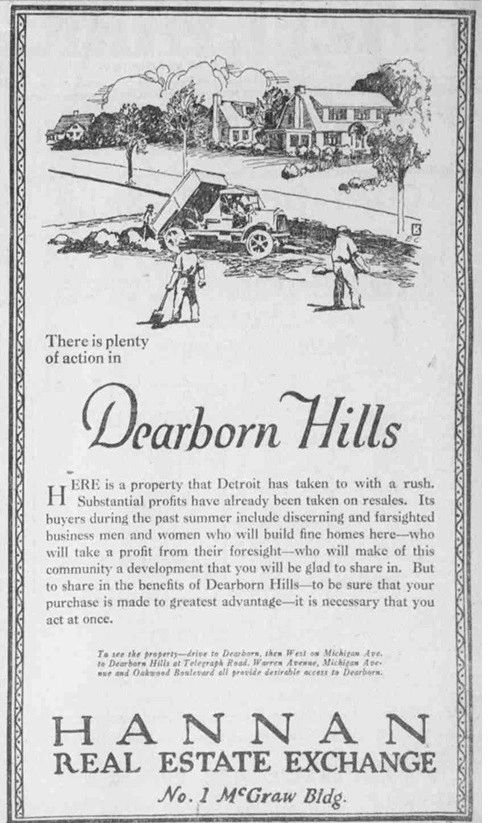
A Brief History of Dearborn Hills
Join us on Monday, Nov. 2 at 7 p.m. when Ian Tomashik will present on 100+ years of architectural and historical highlights
Join us on Monday, Nov. 2 at 7 p.m. when Ian Tomashik will present on 100+ years of architectural and historical highlights
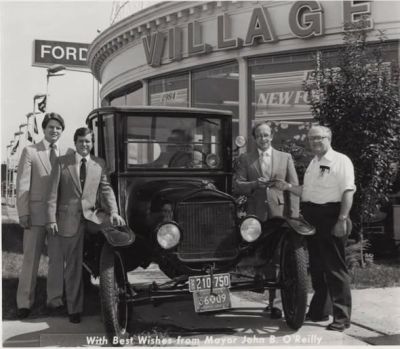
When you drive by the Village Ford dealership on Michigan Avenue, you are driving by an iconic (in design) and historic piece of local history. Village Ford actually had its beginning way back on March 16, 1910 when Addison Ford, a second cousin of Henry Ford, received his dealership license. Eventually the dealership became “Addison Ford & Son”, referring to Clyde Ford who took over from his father and opened a dealership at the corner of Oakman (formerly Porter) and Newman (formerly Mechanic Street).
Clyde’s first garage had actually been on his farm north of Warren Avenue but downtown Dearborn was bustling and the place to be. Clyde also went on to become the first mayor after Dearborn and Fordson united in 1929. According to a Dearborn “Historian” article, Clyde sold the dealership to Stuart Wilson in 1942 once car rationing had gone into effect. Stuart Wilson stayed at the Michigan Avenue -Oakwood location until 1945 when materials became available to build a new sales-and-service at 23535 Michigan Avenue, the site of today’s Village Ford.
Stuart Wilson designed the dealership together with Henry Ford, who donated the chandeliers still hanging there today. The unique, historic showroom was designed to feature a rotunda that imitated the Ford Rotunda, built for the 1934 Chicago Century of Progress Exposition and designed by Albert Kahn, creating a lasting “colonial” look that echoes Greenfield Village. In 1982, Jim Seavitt bought the dealership and renamed it “Village Ford” a dealership which has won many various awards over the years and still maintains its historic look.
Malita, the Model T shown in the photo, was purchased from Clyde Ford’s dealership in 1922 and, housed at the Dearborn Historical Museum, is still an active participant in the annual Dearborn Memorial Day parade.
Research by Mariya Fogarasi, photos courtesy of Village Ford and Dearborn Historical Museum
Visit Preservation Dearborn on Facebook or Instagram for all our features on historic homes and buildings!
Stories From the Sidewalk, a hefty hardcover book at nearly 380 pages published by the Museum Guild of Dearborn, is on sale now at the Dearborn Historical Museum gift shop or available online at https://thedhm.org/books.
To say the least it is an oversized stocking stuffer for the holiday season that every fan of architecture and devotee of history will treasure.
Three years in the making, it is the work of a passionate group of history buffs and researchers. This coffee table book documents over 360 houses and buildings in Dearborn’s Arsenal and Riverbend neighborhoods. With the belief that every house and building has a story to tell, the editors organized the book by neighborhood and street address along with a full-color photograph and details on the history and architecture of each historic resource.
Subtitled, A Walk Through 137 Years That Shaped Dearborn (1833 – 1970) the book is designed as a walking tour of these two charming and historic west Dearborn neighborhoods. It surveys and preserves for future generations the story of Dearborn’s growth from a village on the Chicago Road (Michigan Avenue) to a bustling and thriving city as the area became the automotive capital of the world and the manufacturing epicenter of the Ford Motor Company.
Co-authors and editors Christopher Merlo and L. Glenn O’Kray undertook this project with a sense of urgency to document and preserve the stories of these historically significant houses and buildings before they are either razed or drastically renovated – a fate that has befallen several houses and buildings in the Arsenal and Riverbend neighborhoods.
All income from the sale of the book will go to the Museum Guild of Dearborn.
